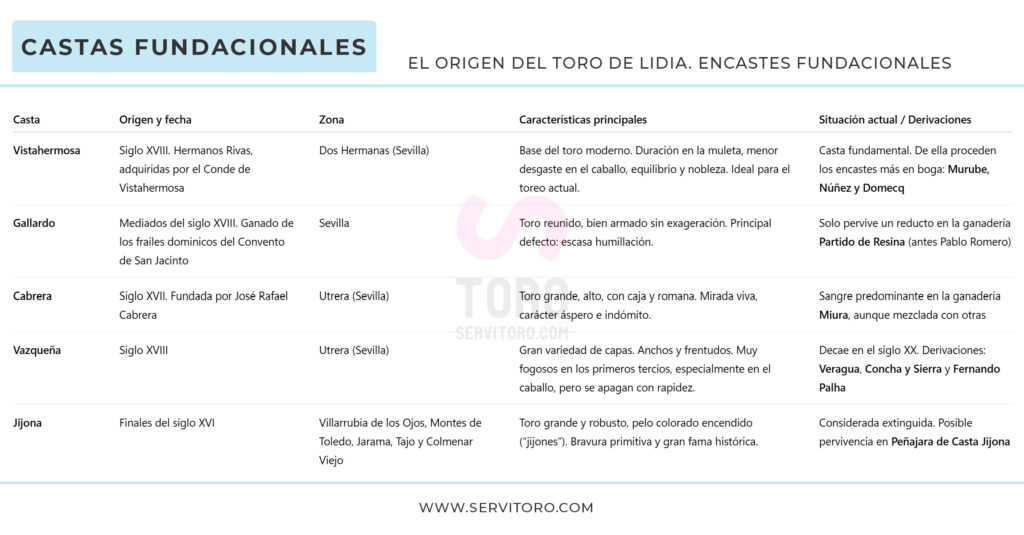
As we explained in a previous article, the term encaste refers to the result of crossing different bloodlines of fighting cattle. All of them originate from what are commonly known as the Foundational Castes, from which the fighting bull as we know it today descends.
With Partido de Resina as the main representative of the Gallardo caste, Miura from the Cabrera line, and Prieto de la Cal and Concha y Sierra from the Vazqueña strain — along with the recent resurgence of the Navarra caste through the Reta breeding programme — almost all other bloodlines derive primarily from the Vistahermosa caste, which has proven to be the most suitable for modern bullfighting.
Throughout this article, we will look at the main bloodlines of today’s fighting cattle and their respective branches, which enrich the genetic heritage of the essential raw material of this art.
PARLADÉ BLOODLINE
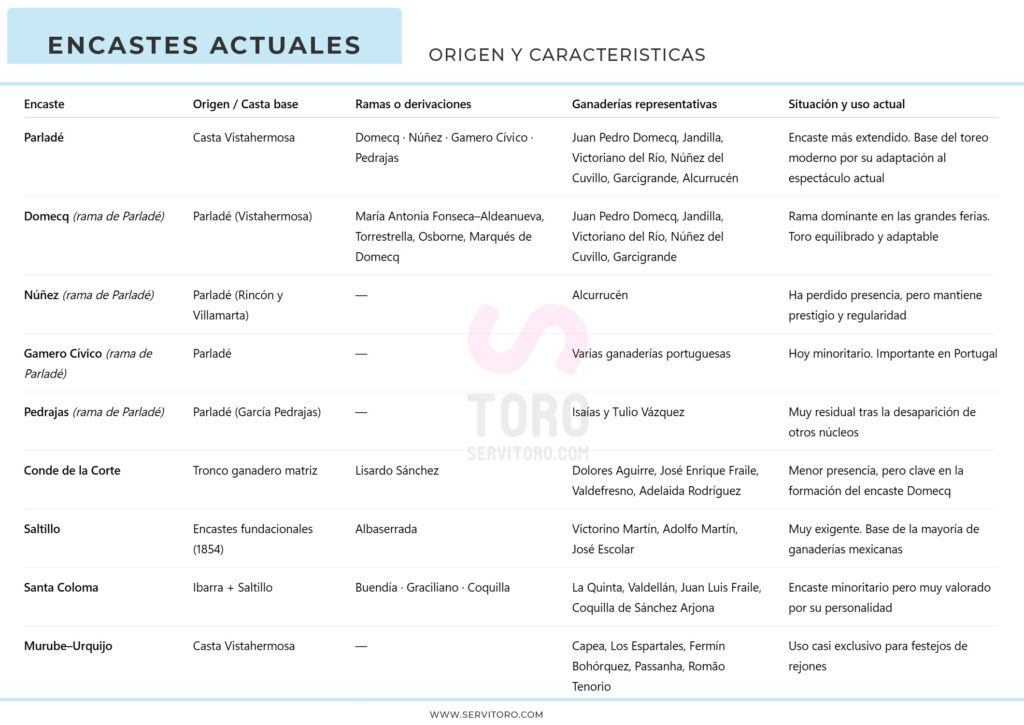
As mentioned earlier, this bloodline originates from the Vistahermosa caste and is divided into four main branches: Domecq, Núñez, Gamero Cívico and Pedrajas.
The Domecq branch, created by Juan Pedro Domecq Núñez de Villavicencio, is currently the most widespread. It has several important offshoots, including María Antonia Fonseca–Aldeanueva, Torrestrella, Osborne and Marqués de Domecq. Some of the most prominent breeding farms from this line — among many that appear regularly at major bullfighting festivals — include Juan Pedro Domecq, Jandilla, Victoriano del Río, Núñez del Cuvillo and Garcigrande.
The Núñez line was created by Carlos Núñez Manso using cattle of Rincón and Villamarta origin. Although it has lost prominence in recent years, it still includes respected breeding farms that appear frequently in major events, with Alcurrucén standing out as the most significant.
The Gamero Cívico and Pedrajas branches are now far less common. Gamero Cívico has strong representation in Portugal, where many leading breeding farms carry this bloodline. In Spain, it was particularly important during the 1970s and 1980s through the Samuel Flores breeding programme, which today no longer enjoys the same standing. Very little remains of the García Pedrajas origin; its last stronghold, following the disappearance of the María Luisa Domínguez line, is the breeding farm of Isaías and Tulio Vázquez.
CONDE DE LA CORTE BLOODLINE
Although it has lost much of its prominence in recent decades, this bloodline can be considered a foundational genetic trunk. In fact, part of the genetic formula of the Domecq bloodline comes from this lineage, dating back to the period when it was owned by Ramón Mora Figueroa.
The most successful branch of this bloodline is Conde de la Corte, along with its extension through Lisardo Sánchez. Breeding farms of this origin that still carry significant weight today include Dolores Aguirre, José Enrique Fraile, Valdefresno and Adelaida Rodríguez.
SALTILLO BLOODLINE
Dating back to 1854, the Saltillo bloodline is one of the oldest. It forms the genetic base of the vast majority of Mexican fighting bull breeding programmes. In Spain, the Albaserrada line predominates, with Victorino Martín and Adolfo Martín as its main representatives, along with José Escolar, whose cattle result from a blend with the Buendía branch of Santa Coloma.
The Santa Coloma bloodline itself is the result of crossing Ibarra and Saltillo cattle. Of its three main branches, Buendía — the most widespread — contains more Saltillo blood, while the Graciliano and Coquilla branches have a greater proportion of Ibarra blood. Breeding farms such as La Quinta (Buendía line), Valdellán, Juan Luis Fraile and Coquilla de Sánchez Arjona continue to uphold these bloodlines in modern bullfighting.
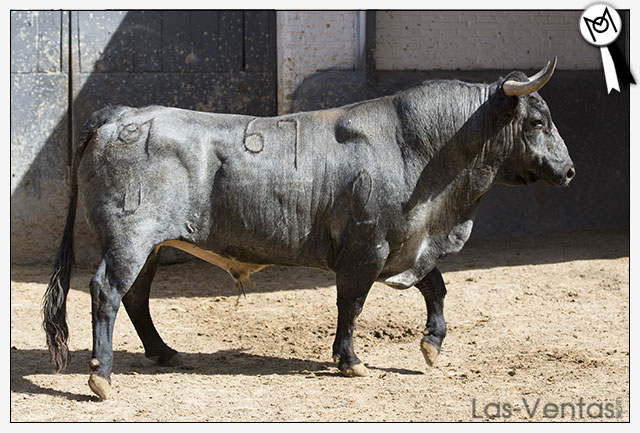
MURUBE–URQUIJO BLOODLINE
Also directly descended from the Vistahermosa caste, the Murube–Urquijo bloodline enjoyed well-earned prestige during the 1960s and 1970s. Today, it is used almost exclusively for mounted bullfighting (rejoneo). Breeding farms such as Capea, Los Espartales and Fermín Bohórquez in Spain, along with Passanha, Romão Tenorio and Guiomar Cortés de Moura in Portugal, are among the most representative of this lineage.
Jose Miguel Arruego
Bullfighting Journalist